|
File Size: 3840x2880 pixlar | 33x24 cm @ 300 dpi | 1.17 MB (jpg) | 31.64 MB (8 bit RGB)
Location: Vaxholm, Stockholms län, Sweden
Date: 2021-11-16
A boat roundtrip Rindö - Stockholm Sweden 2026
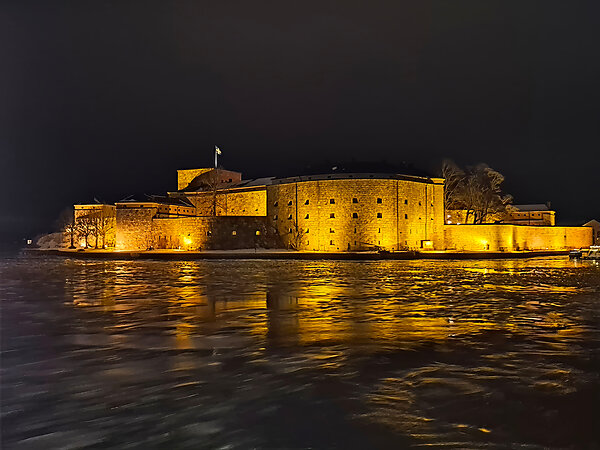
Stockholm Archipelago Sweden 2026 - Waxholm Fortress - A well-lit fortress stands prominently on an island within a dark, calm body of water. The structure, constructed of stone, features a central dome and surrounding walls, illuminated by warm artificial light. The reflection of the fortress is visible on the water's surface, creating a symmetrical effect. The scene conveys a sense of history and tranquility.
Vaxholm Fortress: The Lock of Stockholm
History and Early Origins
The first fortification on the island of Vaxholmen was commissioned by King Gustav Vasa between 1549 and 1558. At this time, it was a simple wooden blockhouse and stone tower designed to control the main sea route into Stockholm. Its strategic importance was proven early on when it successfully withstood two major attacks against the capital.
The Evolution of "The Lock"
For centuries, Vaxholm Fortress functioned as the primary defense for Stockholm from the sea, earning it the nickname "Stockholms lås" (The Lock of Stockholm). The current stone structure seen today was built much later, between 1833 and 1863. This massive reconstruction was prompted by the loss of Finland to Russia in the early 1800s, which left Sweden's eastern coast more vulnerable.
Military Significance
The fortress was designed to be impregnable, featuring thick granite walls and heavy artillery. It played a crucial role in coastal defense, and its presence effectively forced all incoming ships to pass within range of its cannons. However, the rapid advancement of artillery technology during the 19th century eventually rendered the stone walls obsolete against modern explosive shells.
But it once prevented the Danish fleet from passing into Stockholm in the sixteen houndreds and in the seventeen houndreds it prevented the Russions to do the same. On the east of the Island of Rindö just behind the fortress there are a lot of heavy fortifications and especially on both sides of present main deap sea-lane to Stockholm
Modern Day
Today, Vaxholm Fortress is no longer an active military site. Instead, it serves as a cultural destination housing the Vaxholm Fortress Museum, which showcases 500 years of coastal defense history. Visitors can explore exhibitions ranging from military history to life on the fortress in the late 1800s. Vaxholm was demiltarized totally 2005.
Vaxholm Fortress: The Lock of Stockholm
History and Early Origins
The first fortification on the island of Vaxholmen was commissioned by King Gustav Vasa between 1549 and 1558. At this time, it was a simple wooden blockhouse and stone tower designed to control the main sea route into Stockholm. Its strategic importance was proven early on when it successfully withstood two major attacks against the capital.
The Evolution of "The Lock"
For centuries, Vaxholm Fortress functioned as the primary defense for Stockholm from the sea, earning it the nickname "Stockholms lås" (The Lock of Stockholm). The current stone structure seen today was built much later, between 1833 and 1863. This massive reconstruction was prompted by the loss of Finland to Russia in the early 1800s, which left Sweden's eastern coast more vulnerable.
Military Significance
The fortress was designed to be impregnable, featuring thick granite walls and heavy artillery. It played a crucial role in coastal defense, and its presence effectively forced all incoming ships to pass within range of its cannons. However, the rapid advancement of artillery technology during the 19th century eventually rendered the stone walls obsolete against modern explosive shells.
But it once prevented the Danish fleet from passing into Stockholm in the sixteen houndreds and in the seventeen houndreds it prevented the Russions to do the same. On the east of the Island of Rindö just behind the fortress there are a lot of heavy fortifications and especially on both sides of present main deap sea-lane to Stockholm
Modern Day
Today, Vaxholm Fortress is no longer an active military site. Instead, it serves as a cultural destination housing the Vaxholm Fortress Museum, which showcases 500 years of coastal defense history. Visitors can explore exhibitions ranging from military history to life on the fortress in the late 1800s. Vaxholm was demiltarized totally 2005.
Image: 020 Sweden one day February 2026.Topaz
Photographer:
Sten-ÅKe Sändh
Release: Not Released (NR)
Copyright:
© Sten-�ke Sändh
Villkor:
BY-SA
Kan ej köpas
Bilden är inte til salu
Direct link
