|
File Size: 3840x2560 pixlar | 33x22 cm @ 300 dpi | 0.82 MB (jpg) | 28.13 MB (8 bit RGB)
Location: Jerusalem, Israel
Date: 2021-11-16
Global Architecture - iMatch Autotagger AI text test
Global Architecture - Jerusalem Israel 2016
The Shrine of the Book is a landmark building located in the Givat Ram neighborhood of Jerusalem, part of the Israel Museum complex. Built in 1965 by architects Armand Phillip Bartos and Frederick John Kiesler, it was designed specifically to house the Dead Sea Scrolls. The structure is a masterpiece of modern expressionist architecture, featuring a white tiled dome that sits partially underground.
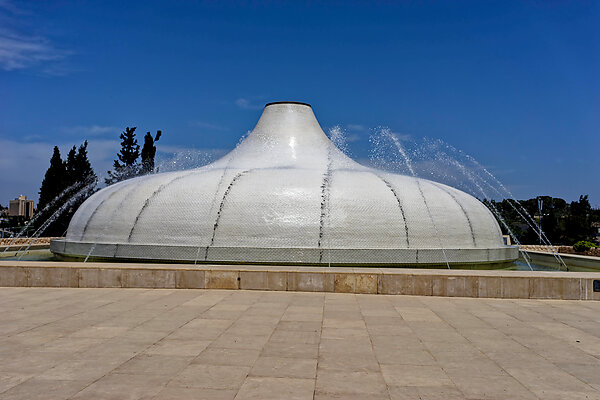
The exterior is defined by its unique parabolic dome covered in white ceramic tiles, which is continuously cooled by water jets. This white dome is meant to contrast with a nearby black basalt wall, symbolizing the struggle between the Sons of Light and the Sons of Darkness described in the scrolls. The surrounding plaza is paved with light-colored stone, and the building is set within a reflecting pool that enhances its sculptural quality.
The facade utilizes a double-curved geometry that was highly innovative for the mid-20th century. The white ceramic finish provides a smooth, reflective surface that gleams under the sun, while the fountain system adds a dynamic element to the static form. This style of symbolic modernism was popular in the 1960s for institutional and commemorative buildings.
Architecture type or style: Modernist
The Shrine of the Book is a landmark building located in the Givat Ram neighborhood of Jerusalem, part of the Israel Museum complex. Built in 1965 by architects Armand Phillip Bartos and Frederick John Kiesler, it was designed specifically to house the Dead Sea Scrolls. The structure is a masterpiece of modern expressionist architecture, featuring a white tiled dome that sits partially underground.
The exterior is defined by its unique parabolic dome covered in white ceramic tiles, which is continuously cooled by water jets. This white dome is meant to contrast with a nearby black basalt wall, symbolizing the struggle between the Sons of Light and the Sons of Darkness described in the scrolls. The surrounding plaza is paved with light-colored stone, and the building is set within a reflecting pool that enhances its sculptural quality.
The facade utilizes a double-curved geometry that was highly innovative for the mid-20th century. The white ceramic finish provides a smooth, reflective surface that gleams under the sun, while the fountain system adds a dynamic element to the static form. This style of symbolic modernism was popular in the 1960s for institutional and commemorative buildings.
Architecture type or style: Modernist
Image: Israel_20016_271 P3 4K
Photographer:
Sten-ÅKe Sändh
Release: Not Released (NR)
Copyright:
Sten-�ke Sändh
Kan ej köpas
Bilden är inte til salu
Direct link
