|
File Size: 2567x3840 pixlar | 22x33 cm @ 300 dpi | 1.77 MB (jpg) | 28.2 MB (8 bit RGB)
Location: Tel-Aviv, Israel
Date: 2021-11-16
Global Architecture - iMatch Autotagger AI text test
Global Architecture - Tel-Aviv Israel 2016 - Trel-Aviv Hilton Hotel
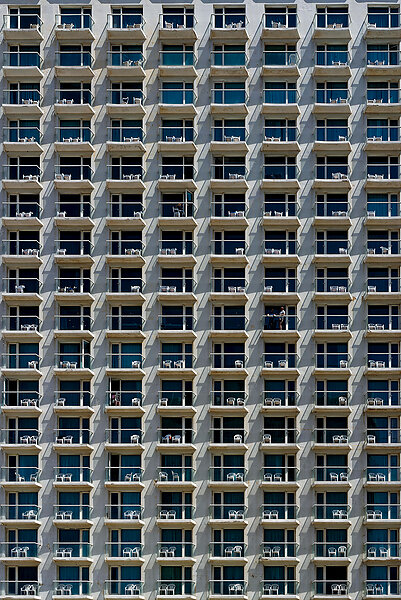
A close view of a tall hotel facade filled with repeating balconies and blue-tinted windows. The concrete grid and angled balcony dividers create a strong geometric pattern across the entire frame. This building is the Hilton Tel Aviv, situated in Independence Park, Tel Aviv. It was built in 1965 by architects Yaakov Rechter and Werner Joseph Wittkower and was originally used as a luxury hotel.
The design emphasizes modular repetition and deep balcony recesses that cast sharp shadows, giving the elevation a textured, sculptural look. The facade shows a rhythmic arrangement of white concrete frames and glass railings. Small white chairs are visible on many of the private outdoor spaces, adding a human scale to the massive structure.
The architecture features a brutalist influence with its heavy use of exposed concrete and functionalist modularity. This style was most popular during the mid-20th century, specifically the 1950s through the 1970s. The facade uses a honeycomb-like structure to provide shade and privacy for guests while maintaining a uniform aesthetic.
Architecture type or style: Modernism
A close view of a tall hotel facade filled with repeating balconies and blue-tinted windows. The concrete grid and angled balcony dividers create a strong geometric pattern across the entire frame. This building is the Hilton Tel Aviv, situated in Independence Park, Tel Aviv. It was built in 1965 by architects Yaakov Rechter and Werner Joseph Wittkower and was originally used as a luxury hotel.
The design emphasizes modular repetition and deep balcony recesses that cast sharp shadows, giving the elevation a textured, sculptural look. The facade shows a rhythmic arrangement of white concrete frames and glass railings. Small white chairs are visible on many of the private outdoor spaces, adding a human scale to the massive structure.
The architecture features a brutalist influence with its heavy use of exposed concrete and functionalist modularity. This style was most popular during the mid-20th century, specifically the 1950s through the 1970s. The facade uses a honeycomb-like structure to provide shade and privacy for guests while maintaining a uniform aesthetic.
Architecture type or style: Modernism
Image: Israel_2016_46 P3 4K
Photographer:
Sten-ÅKe Sändh
Release: Not Released (NR)
Copyright:
Sten-Åke Sändh
Kan ej köpas
Bilden är inte til salu
Direct link
